How to put Agentic AI to work (Triple-A Framework)

“Reflexive AI usage is now a baseline expectation at Shopify.” — Tobi Lütke
Why it works
Tobi Lütke (pictured) is a German-Canadian programmer and a co-founder and the CEO of Shopify. He was born in Koblenz, Germany, in 1980, left school at 16, and trained as a programmer as an apprentice at Siemens. In 2003, he moved to Ottawa to be with his Canadian girlfriend, who later became his wife. In 2004, he and two partners tried to open an online snowboard shop called Snowdevil. None of the shop software he could find was any good, so he wrote his own. The snowboard shop is long gone. But in 2006, the software he wrote for it became Shopify. Today, that company is valued at more than $180 billion.
In April 2025, he sent a memo to everyone at Shopify. In the memo, he calls AI a multiplier and says he has watched people get “100X the work done.” He tells teams to start every new project with AI, because early work is about learning fast, and AI learns faster. He also has a hard rule. Before a team can ask for more people or more budget, it has to show why AI can’t do the job. And he leaves them with one question to ask themselves: What would this area look like if autonomous AI agents were already part of the team?
For the past few months, this newsletter has been all about agentic AI. That means AI that carries out whole pieces of work on its own, instead of answering one question at a time. In the July edition, I covered the first step. Start with the end in mind: your professional and personal goals. In the August edition, I introduced the second step, the PATS framework, for setting agentic AI up with Projects, Artifacts, Tasks, and Skills. Today’s edition is the third step, and Lütke’s rule is the way in. He makes his teams ask whether AI could do the job. The Triple-A framework tells you what to do with the answer.
How to do it
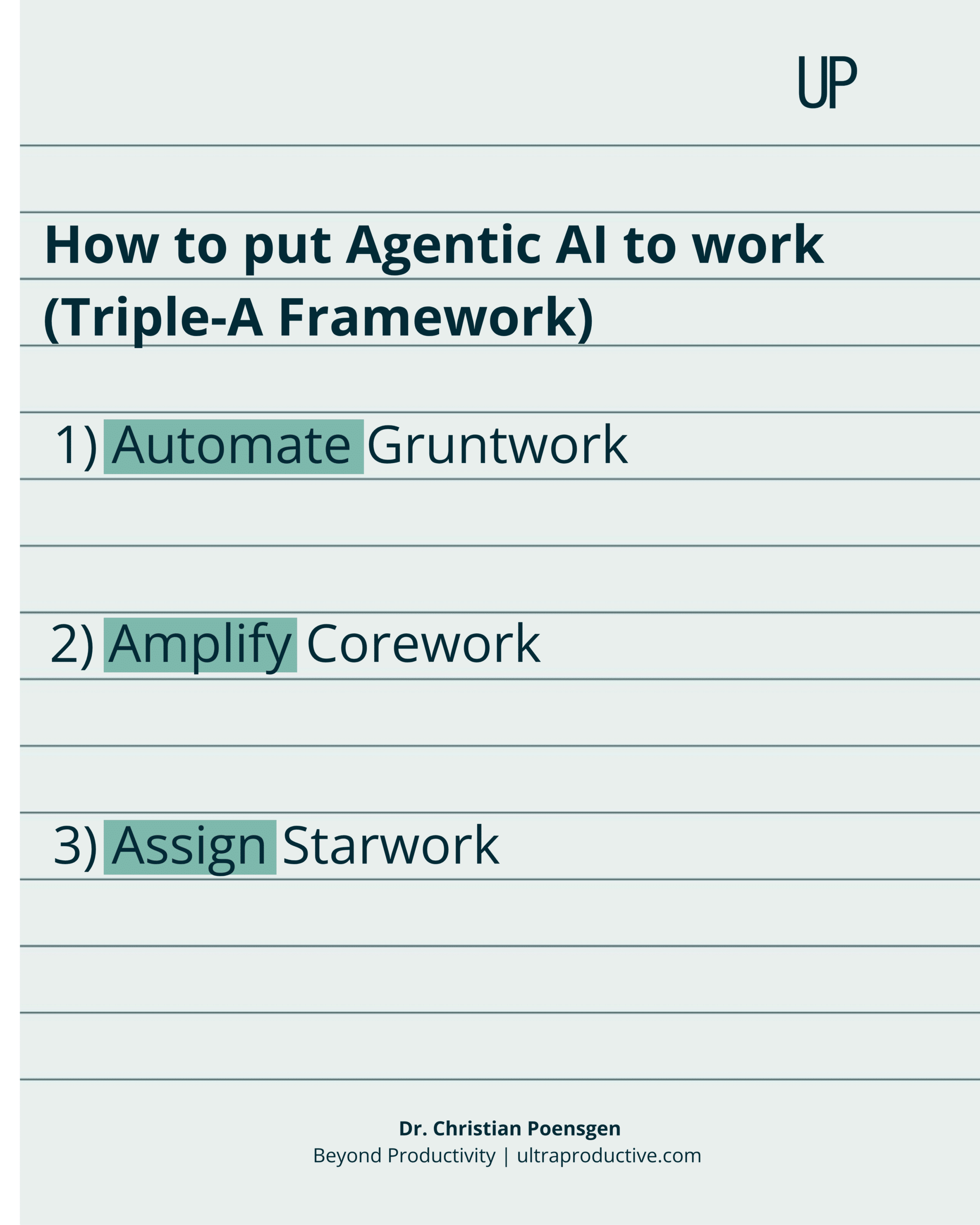
1) Automate Gruntwork
Gruntwork is the work nobody should be doing. It has to happen, but it creates only indirect value while it happens. The constraint here is value, and there’s no version of an expense report that’s worth hours of your time. To find your Gruntwork, ask what you’d rather not do at all.
Take the example profit goal I wrote about in July: increase profit by 20 percent this year. The Gruntwork it drags along is the admin around the sales function. Logging calls in the CRM. Writing up notes after meetings. Pulling the same numbers into the same Monday report. Sending the second follow-up to someone who has gone quiet.
With minor setup, all of this is automatable. Then you rarely have to touch this work again. For example, you can set up a Task, a standing instruction that runs on a schedule, that reads your calendar, inbox, and meeting records before creating draft emails each evening. In the morning, you review and send. The work still gets done, and your hands are off it.
If you can’t name your Gruntwork, ask Claude: “Look at my calendar and any emails I sent in the last three months. List the ten things I do most often that create the least value, and tell me which ones you could take over.”
2) Amplify Corework
Corework is the work you should be doing. It’s your actual job, the part nobody can take off your plate, and you’d do more of it if the days were longer. The constraint here is time. To find your Corework, ask yourself what you’d do if you had more of it.
For the profit goal, the Corework is the selling itself. Discovery calls, writing good proposals, and the conversations where a deal is won or lost. You should amplify this work. That means doing the same work, but better and faster instead of handing it away.
Before a call, have Claude pull everything you know about the account and hand you the three questions worth asking. After the call, have it draft the proposal from your notes and your best past proposals. Then, you edit instead of starting from a blank page. You do the same work. You just walk in better prepared and leave with more of it finished.
If you can’t name your Corework, ask Claude: “Go through my calendar from the last three months and compare it against my goal of increasing profit by 20 percent. Which of those hours actually moved the goal, and which did not? Then tell me where I should be spending more of my week.”
3) Assign Starwork
Starwork is the work experts should do. The constraint here is ability. It’s work that requires a different skillset than yours, but hiring someone for it was never worth the cost. So it never got done at all. To find your Starwork, ask what you’d want to get done if you had world-class experts on call.
For the profit goal, that might be the competitor teardown you’d normally need a strategy analyst for. Elsewhere, it’s the deck that looks like a designer built it, or the contract you’d want to have reviewed by a legal expert before it goes to your lawyer.
With today’s highly capable AI, you can assign these tasks to an expert agent. So find a prebuilt skill or create one yourself. Skills are reusable sets of instructions you write once and use again and again. They capture the knowledge, methods, and language of an expert and apply them to a specific type of work. Skills give your agent superpowers and turn it into an expert data analyst, designer, developer, or almost any other role you might otherwise have needed to hire.
If you can’t name your Starwork, ask Claude: “Given my goal of increasing profit by 20 percent this year, what analysis would a top consultant run that I have never done, and in what other ways could expert knowledge be useful here? Share the three most valuable with me.”
The first pile, Gruntwork, is the easy one to stop at.
The second, Corework, is where your week actually goes. You can’t buy more hours for it, so you make the ones you have count for more.
The third, Starwork, is where the surprise sits. It’s full of work you wrote off years ago. You couldn’t do it yourself, and you couldn’t justify paying someone who could. Now you have AI to hand it to.
Here’s my question for you this month:
Are you holding back on agentic AI because you don’t know where to start?
And here’s my challenge for you:
Take one hour this week and sort your work into the three piles.
Then pick one item from each.
Automate the Gruntwork that’s been eating your time.
Amplify the Corework that actually moves the goal.
Assign the Starwork you’ve put off the longest.